


I was recently ordained as a minister of the Christian Church (Disciples of Christ) denomination on February 8, 2026. When I was picking out a design for my stole, I knew that I wanted it to represent three things: my covenant to Christ and the Church, the Wilderness, and my identity as a gay man. And what should I stumble across but a stole that has a wilderness landscape in somewhat Pride colors with a Celtic cross on the nape of the neck! It’s perfect. A stole represents, in part, the yoke of responsibility that a minister is taking on as they step into their pastoral role. And my responsibility is to Christ and the Church, a queer God and a queer community that transcends categories and definitions, and to this beautiful beloved wild world.
I fell in love with the wild when I was very little. I grew up in a house with a forest for a back yard. The forest was a giant ravine that dipped down about a hundred feet into a shallow creek at the bottom. I spent my early childhood playing all throughout that forest. There was an overhanging rock on the other side of the ravine from my house that I used to hang out in. I put two rocks under it and a two by four across them to make a little bench. I used to sit under the overhanging rock and listen to the birds. The rock was clear on the other side of the ravine from my house, but I managed to scramble down the steep side of the ravine, using my well-worn path in the brush, using a trusty tree root that stuck out at the bottom that allowed me to steady myself before jumping down. I could then race up the slope on the other side to get to the overhanging rock – all within about a minute and a half.
One day, on the other side of the forest from the overhanging rock, I heard a sudden rustling in the brush and stopped dead in my tracks. From under a fallen log, I saw a mother armadillo suddenly charge out followed by a small line of her pups. They just trooped away from me, barely paying me any mind. I named that portion of the forest Armadillo Alley. It was right next to a pumpkin patch that had formed after years of my family rolling old pumpkins down the side of the ravine after Halloween, causing their seeds to germinate and grow.
There’s an Easter egg time capsule filled with trinkets buried under a tree toward the northern treeline that will probably never be unearthed.
I remember one afternoon where I was standing at the bottom of the ravine, my feet straddling the small creek, and I took in the beauty of the forest all around me. I must have only been about nine or ten years old, but I remember gazing up at the sunlight streaming down through the leaves. The tree trunks all around me were pillars, their leaves an emerald ceiling, and the sunbeams were celestial curtains. And in my young mind I somehow knew that I was in God’s temple. At least that’s how I remember it now.
We can live in a different world when we’re young. We don’t just see a forest. We don’t just see trees. We see magic at play. We can feel the soul of the Wild World and when we play amongst its trees our souls meet the Wild’s and we become part of the symphony, strangers no more. We step into the wardrobe and enter the amazing world on the other side. We fall down the rabbit hole. We step into the fairy ring. And then we are in the liminal, sacred space beyond the patterns of the civilized, industrial world.
The story of the Transfiguration in Matthew 17:1-9 is such a step behind the curtain.
Six days later, Jesus took with him Peter and James and his brother John and led them up a high mountain, by themselves. And he was transfigured before them, and his face shone like the sun, and his clothes became bright as light. Suddenly there appeared to them Moses and Elijah, talking with him. Then Peter said to Jesus, “Lord, it is good for us to be here; if you wish, I will set up three tents here, one for you, one for Moses, and one for Elijah.” While he was still speaking, suddenly a bright cloud overshadowed them, and a voice from the cloud said, “This is my Son, the Beloved; with him I am well pleased; listen to him!” When the disciples heard this, they fell to the ground and were overcome by fear. But Jesus came and touched them, saying, “Get up and do not be afraid.” And when they raised their eyes, they saw no one except Jesus himself alone.
As they were coming down the mountain, Jesus ordered them, “Tell no one about the vision until after the Son of Man has been raised from the dead.”
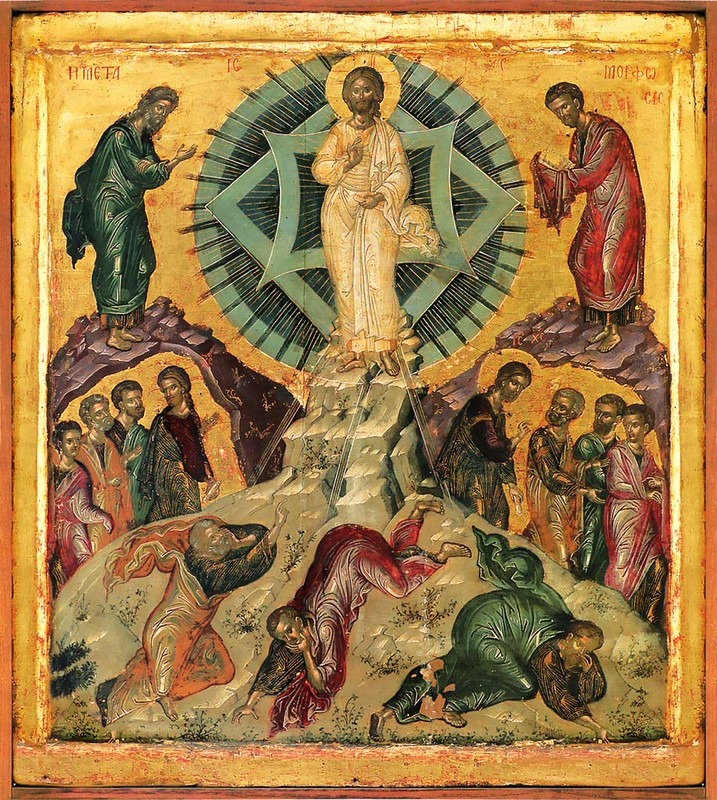
We are escorted into a story that the church has named “The Transfiguration.” Jesus takes His three most trusted disciples – Peter, James, and John – and brings them to the top of a mountain. And suddenly Jesus’ face changes and shines as bright as the sun. When Luke tells this story in his gospel, the text uses heteron, which means that Jesus’ face “became other.” Jesus became strange. And then immediately afterward, Moses and the prophet Elijah appear next to Jesus and the three are seen talking amongst themselves. Again, in the Luke version of this story Moses and Elijah are also said to be “in glory” as they are speaking with Christ. This can be taken to mean that all three are meant to be seen as shining in a strange brilliance. It’s a strange brilliant secret meeting and the disciples are not invited to hear what they are saying, only to watch in wonder.
It’s a magical, weird scene. I really like how the Icon of the Transfiguration (pictured above) makes it look. In this icon, Moses and Elijah are actually bowing to Christ. And the disciples are just terrified. We have these two figures from deep within Jewish history and legend: Moses: the one who led the Jews out of captivity in Egypt, introduced the Commandments to his people, conversed personally with God on the peoples’ behalf, and led them to within sight of the Promised Land. And then Elijah: an incredible miracle worker who led a school of prophets, and who is said to have ascended bodily into Heaven. And he is prophesied to come again, and is therefore a quasi-messianic figure in his own right. And then we have Jesus, the continuation and fulfillment of this story – this lineage of earth-shattering figures from Israel’s past. The Messiah and Savior of the entire cosmos. And these three are talking to each other.
This story is linking Christ with the rest of the Jewish story. There is immense continuity here with the narratives that we have in the Hebrew Bible. For example, this is the second time that we have Moses’ face shining like the sun. Moses’ face shines just like that when he is climbing down from another mountain, Mt. Sinai, while carrying the Ten Commandments. And Jesus’ disciples would have been able to remember that story, the Ten Commandments are a foundational aspect of Jewish spiritual life.
But then we have what is to me the strangest part of the story. Peter steps forward and says that tents should be set up for these new visitors. And suddenly a bright cloud appears and enshrouds the whole scene. And the voice of God comes out of it. Again, this hearkens back to Torah, to the Hebrew Bible. God also appears to the Jewish people there as a cloud as they are being led in the Wilderness.
I’ve always loved the idea of God appearing as a cloud, especially in a scene like this. This is such a magical encounter. And I think that’s exactly the way that the text wants us to approach the Divine. It’s like a magic trick. But even more than a magic trick, it also shows God as Mystery – God as uncontainable wonder. This is not a God that can be contained within a definition or a box. This is a God who speaks out of a cloud on top of a mountain while bringing ancient people back from the dead for a chat.
God is queer. Queerness is the transcendence of definition – or perhaps even the active escape from definition. I believe that, especially in stories like this one, God is presented as beyond categories. And there are queer people in the church. I am one. And the church is not the building, but the people. So that must mean that the church is queer. And we all bear the image of God, the Imago Dei. So that must mean that God is queer. This is a deeply queer narrative. God is showing off God’s transcendence in this account. This is why one of my favorite theologians, Rudolf Otto, refers to the experience of God as the Mysterium Tremendum – the Tremendous Mystery, where we are only able to express awe in response to something that defies everything we thought we knew. The disciples can only cower and quake as their conceptions and expectations of the world are destroyed.
And Peter’s completely reasonable request, that tents be made to house the three men, is met with this queer God seemingly freaking out! God says, “This is my Son, the Beloved; with him I am well pleased; listen to him!” I used to think that was an absolutely bizarre response to such a normal suggestion. What was so wrong about Peter’s suggestion? Peter’s mistake was in thinking that Jesus was just another link in the chain. When Peter suggested that tents should be set up for Moses, Elijah, and Jesus he was putting equal emphasis on all three. And YHWH has to step in and assert reality. Jesus is the Son of God. Listen to Him! Moses and Elijah are at Jesus’ side and we never hear them say a word throughout this entire story. They almost look more like attendants for Jesus. Jesus is uniquely God’s beloved Son, and we are uniquely called to listen to His words, to live our lives as followers of Christ. The attention of this moment is meant to be on Jesus.
And then, as the disciples are cowering on the ground, in the throes of this Mysterium Tremendum, Jesus walks over to them and touches them. He tells them to get up, and to not be afraid. And when they open their eyes and look around it’s just them and Jesus on the mountain and they are suddenly out of Wonderland. God has just terrified these poor guys. They are being faced with something beyond comprehension. And Jesus sees this and gently brings them back to themselves. Of course, we don’t actually know if Moses and Elijah have truly left the scene or if the disciples are just unable to see them anymore. But that’s the nature of Mystery – we can never truly know.
This is what we call a Wilderness story. Wilderness stories, throughout Scripture, are moments in the Bible where a person is separated from the patterns of the Empire. They are taken aside and brought into a wild place. Jesus is tempted by Satan in the Wilderness. Hagar, Abraham and Sarah’s slave who was forced to bear Abraham’s child, met God in the Wilderness and she became the first person in Scripture to give God a name, El-Roi – the God who sees me. John the Baptist is a representative from the Wilderness who comes to the Empire to proclaim the arrival of Christ. And this story, again, draws the people within it outside of the normal and they encounter the Divine.
The Wilderness is a wild place. It is uncontrollable. It cannot be managed. It is untamed. It is unpredictable. And it is in that liminal space outside of our societal patterns where we keep meeting our Creator. Romans 12:2 tells us to “not be conformed to the patterns of this world but to be transformed by the renewing of our minds.” Dare I say that our very minds are meant to be transfigured? In order to orient ourselves toward the compassionate heart of Christ rather than the patterns of the world? What are the patterns of the world? Sexism, homophobia, transphobia, racism, genocide, xenophobia, ableism, greed, ego, patriarchy, nationalism, and you can fill in the rest. The Wilderness where people keep meeting the Divine is outside of these patterns.
The veil that covers our perception of reality is being torn aside in this story and the disciples are shown the world as it truly is. The world is teeming with the glory and presence of God. And that is how I know that the world is inherently good; because when we truly see the world as it truly is, without the interference of our capitalist hellscape that we’ve manufactured or the fascism that storms our streets or the AI that pervades our screens, we are able to see that this place is truly beautiful and holy.
I like to think that the story of the Transfiguration is not necessarily about that mountaintop undergoing some sort of change so much as it’s about the disciples’ perceptions of the mountaintop being momentarily changed. The mundane is pushed aside and the vibrant and perhaps insane life hidden behind the veil is revealed. It’s like prayer in that way. We do not pray because we are trying to grow closer to God so much as we are trying to heighten our awareness of the reality that God is always present with us regardless of what we do. Maybe Jesus was always shining with the brilliance of the glory of God. And the disciples were able, for just a brief moment, to see it for the first time.
But this is not just a story about a merely infinite, merely transcendent god. Because as we remember, the focus of this narrative is Jesus. God tells the disciples, out of the cloud, to listen to Jesus. And then what does Jesus do immediately after? He reaches down and touches the disciples and says, “Get up, and do not be afraid.” That is the word of the Lord. Listen to Him! When faced with the glory of God our Mother, the Son tells us to not be afraid. Because the glory that is being shown to us is not just of a transcendent infinite God but a God who is down in the good soil with us, who suffers with us and who loves us deeply.
I am so grateful that I was given a Wilderness when I was a child. I love that I grew up with a big forest for a backyard. And when I raced down one slope of that ravine and up the other to get to my overhanging rock, the forest did not change for me. The forest did not change into a cathedral for God when I looked up at the branches. Rather, that forest is a temple for God. And with my child’s eyes I was able to appreciate it in its actuality. It’s only when we get older that a forest just becomes another biome. We lose touch with the magic that exists within everything because the patterns of the world have put that veil over our vision.
There are a lot of powerful people in this world, like our current regime, who seem to earnestly think that the only thing that the world is good for is exploiting it. Exploiting us, the people, using our fear and insecurities to turn in our neighbors. And they are exploiting our planet’s resources. I think that this is because they have failed to see Christ in the humanity of their neighbors and the inherent sacredness of our food Earth. They have become nihilists, believing in nothing but their own power. They fail to see the glory of the world as it already is.
I am not telling you to go find a mountaintop to find God’s glory, although mountain summits are beautiful and I think they can help us to appreciate the glory of God’s handiwork. I’m not telling anyone to go become some forest hermit. I think what these Wilderness narratives are telling us is that wherever we are in the world, it is already holy and sacred and profoundly magical in nature. We only need to have the veil taken away from our eyes for a bit so we can see the actual reality of our God-saturated world. Let us continue to be a community of hope and light. Because it’s with that communal love of one another and our neighbors that the veil is torn and we actually see the glory of the world.