

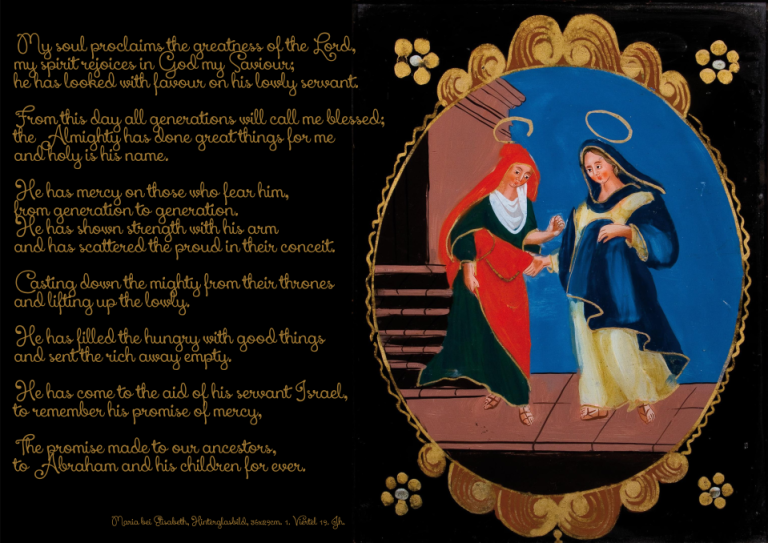

Had a weird moment in church today. Someone was reading the Magnificat — Mary’s spontaneous, prophetic words of joy in a moment of inspiration when meeting her cousin Elizabeth. It’s full of encouraging and hopeful words about God coming to the aid of the poor and downtrodden, and how he will pull down the seats of the rich and proud, how the hungry will be fed with good things, and the rich will be sent away empty-handed. These are meant to indicate the kind of kingdom and rule that will be inaugurated by the child in her womb.
And I got angry. Angry because for 2000+ years people have been waiting for the fulfillment of those words. It didn’t happen then, and it hasn’t happened since. And I wondered defiantly if more people had died and suffered from oppression, starvation and privation since the time of that so-called prophesy than even in all the centuries before it.
And the thought came to me: someone sold her a full bill of goods, and people have been buying into it for centuries. When we gonna wake up and realize it’s a fiction? That it’s never gonna happen? Waiting for that idyllic fantasy of a glorious Coming Age where God rules the world with justice and peace — it’s exactly the kind of drivel conquerors and despots feed the conquered sheep to redirect their hopes and energies to someplace other than reality in the here and now.
Or, put more bluntly, we Christians have been buying into this illusion (delusion?), and it effectively immunizes us from doing anything. This world is in chaos — just look at the news on ANY given day — and has always been that way. Nebuchadnezzar didn’t fix it, neither did Cyrus. Not Alexander, not Augustus Caesar. And not the American founding fathers and mothers. We keep pushing the deadline back further and further, off into the “any day now” that never seems to come. In Christian lingo, we’re still waiting for the Second Coming and the Millennium that never quite seems to get here.
Maybe we got it all wrong.
And that’s the second thought that came to me, sitting there in church listening to Mary’s Song.
The evangelical escape theology: Mary was never talking about *actual* kingdoms, or *actual* justice, rebalancing the score or “redistributing the wealth.” She’s talking “spiritual language,” about “individual salvation.”
Ugh. Yeah. I hate it. But I think in this case it’s actually right. Why? Cuz this next thought hit me almost immediately:
Nations don’t enter into Eternity. Communities do not cross over into the Next Realm of Existence together. All people from all time may ultimately stand before the Almighty at some distant Great Judgment, but we face God one at a time. We pass into eternity as individuals.
That fits better with my perspective of reality, my cosmology. We all individually carry a divine spark, the essence of divinity within us. And when we transcend the limits of a physical body, we reconnect with that Source. Some people think we are reabsorbed into it, the wave returning to the ocean. Something inside me rebels against that idea forcefully. I can’t accept any other idea than that we maintain our individuality — that that is the ultimate manifestation of Love. Love needs an “other” to focus its energy on, to interact with, to commune with. Love requires a beloved. And the supreme gift of Love to the beloved is their eternal individuality — you will always be you, forever. Just a better, whole and healed, expanded version of you.
So if we cross over into Infinity as individuals, where we step into a fuller existence, why then would those prophetic promises of redemption and deliverance NOT apply to the individual rather than a nation or ethnic or religious group as a whole? Mary and all those former prophets may well have understood them to apply more broadly, even universally, but a modern spiritual sensibility recognizes the individual component.
What does that mean? How does the Magnificat apply to me as an individual, rather than as a promise to a redeemed nation of Israel or some future Christian era?
By accessing and tapping into that Divine Spirit that we are all so integrally and inescapably tied into. By living into our fuller being as Children of God. By walking in peace and forgiveness, in letting go of attachments and expectations. And remembering that we *always* have access to divine grace and mercy, to forgiveness and another chance to do it better. “God has helped his servant and remembered to be merciful. He made this promise to our ancestors, to Abraham and his children forever.”
We are those children. Individually. And so — somehow — we must translate those prophetic promises of a just and peaceful world, where no one goes hungry, where no one is too “lowly,” and where all are blessed, into our everyday reality.
As much as I can detest and argue against the perils of an individually-focused “salvation” message — “I’ve confessed Jesus as my personal Lord and Savior,” and screw everybody else — I have to admit that it IS the foundation of a vital spirituality — and justice.
So. What do I/we do with this? Obviously, it’s a call for ME to take individual action. To be aware of the needs of my neighbor and to *personally* make an effort to meet those needs. To personally make an effort to extend peace — in intellectual debates, in political arguments, and in the Walmart parking lot. In my own heart and mind. I must tap into that Divine Presence to guard the peace of my own being, and to access the riches of that Presence and extend them into every area of my life and the lives of those around me. It is a call to action, to be sure. I can’t just light a candle at Christmas, and sing some nice songs. If eternity is only accessed on the individual level, so must be the exercise of that redemptive power.
That thought almost made me laugh, right there in the sanctity of a church service. From a moment of anger and outrage, shifting to the argument of a new perspective, adjusting my current worldview … and ultimately walking away satisfied. Yeah, I can live with that.
Of course, community DOES have a role to play. It’s hard to make large or systemic change without the help of others of a like mind. Contemplation and transformation require action, and there’s a synergy when I work with others — and because I’m braver with friends!
It’s really not all that complicated. Or idyllic. Or some distant future hope. Or even just religious wishful thinking. It’s a here-and-now kind of thing. As that great composer wrote, “Let there be peace on earth, and let it begin with me.”
Artwork: Deutsch: Werkstatt Sebastian Winterhalder, Rötenbach, Schwarzwald ; edited by Eugenio Hansen, OFS, CC BY-SA 3.0, via Wikimedia Commons
