



I remember having a long conversation with a young queer person in the outdoor forum of our conservative Church of Christ university. They had recently realized that they were nonbinary, but their parents were conservative fundamentalist missionaries. They had begun the phenomenal undertaking of a much-needed deconstruction of the evangelical faith that had been handed to them by their parents. They were asking me if I had any advice on how to talk about this deconstruction with their parents, especially their father. They revealed to me that their father used to be Roman Catholic but had switched over to the Churches of Christ denomination at some point before my friend had been born. This caught my attention, and I suggested to them that that was actually a possible nexus where their father and them can meet theologically. Their father may decry deconstruction at first, but then come to realize that he had to deconstruct the faith that he had been given in order to switch denominations! Both him and his queer child could thus share in their deconstruction journeys together rather than have the nonbinary kid’s deconstruction be a point of departure in their relationship. My friend was enthusiastic about this idea, having not considered that deconstruction actually seems to have run in their family, at least as far as their father was concerned.
Of course, this idea comes with some caveats. Obviously, the father may not be receptive to that perspective. He may dismiss such a claim as nonsense, coming up with some way to argue that what he had experienced is nothing like deconstruction, at least not like the deconstruction that his nonbinary child has had to undergo. But the reality is that everyone who reexamines the faith that has been handed to them during their upbringing and throughout the rest of their life must deconstruct their faith. It is simply a part of spiritual maturation.
Something that high-control religion won’t tell you is that deconstruction is all over Scripture. People are deconstructing all over the place in The Bible. Moses deconstructed when YHWH introduced godself in the Burning Bush. Turns out God has been queer unnamable Magic this whole time. Job deconstructs when he learns that he can, and perhaps even should, rage at God, and that the Universe is a wild and untamable place.
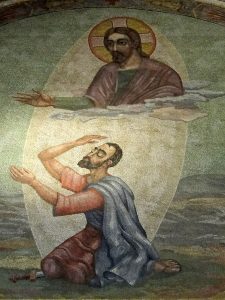
And then we can’t forget about the Apostle Paul of Tarsus – the often hated author of a huge chunk of the New Testament who has been quoted over and over again by homophobes to justify their hatred of people like me. Paul deconstructs in a pretty major way. Paul has assumptions about God that he got through his schooling as a Pharisee, his particular branch of first century Judaism. He has assumptions about who is in and who is out. And then he gets literally blinded in the middle of the road and his world is forced upside down.
I used to think of Paul as a fundamentalist conservative’s dream apostle. But then you encounter passages like the one below. When you read through Paul’s writings, you get this fascinatingly convoluted theology. He is all over the place depending on what letter of his you’re reading. One minute he’ll be saying something wildly homophobic, like God turned people gay because they worshiped idols (Romans 1:22-27), and the next minute you’ll be reading Galatians and Paul will be openly declaring that gender is a construct (Galatians 3:28)! I think that we get a picture of this deconstruction in last week’s Lectionary reading. Paul is deconstructing the God who he thought he knew. This is the oft-quoted Romans 13:8-14:
8 Owe no one anything, except to love one another, for the one who loves another has fulfilled the law. 9 The commandments, “You shall not commit adultery; you shall not murder; you shall not steal; you shall not covet,” and any other commandment, are summed up in this word, “You shall love your neighbor as yourself.” 10 Love does no wrong to a neighbor; therefore, love is the fulfilling of the law.
11 Besides this, you know what time it is, how it is already the moment for you to wake from sleep. For salvation is nearer to us now than when we became believers; 12 the night is far gone; the day is near. Let us then throw off the works of darkness and put on the armor of light; 13 let us walk decently as in the day, not in reveling and drunkenness, not in illicit sex and licentiousness, not in quarreling and jealousy. 14 Instead, put on the Lord Jesus Christ, and make no provision for the flesh, to gratify its desires.
At first, this can come across as just another one of those toxic takes that many evangelicals grew up hearing: that being a Christian means believing that your body, your “flesh,” is bad and you need to neglect it in order to lift up your “spiritual” self. But that gnostic reading fails to see the verses that come before. Paul is undergoing a radical deconstruction of his theology before our very eyes.
|
Ultimately, what Paul means when he talks about “Flesh” is the desire to rule, to control. It has nothing to do with condemning bodies or sex.
|
Paul has just got done talking about a different way of interpreting the Law that he has been spending his entire life studying and by which he has lived. Paul is a Jewish theologian who has spent his life studying the Law of Moses – the sacred Law of Torah that is at the heart of Jewish theology. The Law is crucial because it sets the Jewish people apart from the various Empires that surround them. If you get conquered, you live according to the Torah, not according to the imperial norms of whoever just conquered you. You love the foreigner who resides in your land. You welcome the stranger. And yes, there were the purity laws, but those served to separate the Jews from the colonizers who occupied them.
But living according to strict purity laws can also have devastating effects on the way that one thinks about the world, themselves, and God if you forget what is at the core of the teaching. Religious laws by themselves just work to keep the people you don’t want in your community out and to prop yourself up. So Paul gets blinded on the road to Damascus and has a sudden confrontation with the God of Torah and discovers that the Law of God is based solely on loving your neighbor as you would love yourself, not on who is in and who is out.
Paul is not deconstructing by throwing out everything he was ever taught. His deconstruction is actually about finding what is at the core of what he has been taught and bringing it out to the forefront. That’s not always going to be the case for everyone. Sometimes you need to completely start over from scratch. But for Paul, he came to realize that the Law was not something to be thrown out, but that its religiosity can be misused to hurt people. Torah can be so misused that Paul was able to justify murdering Christians before he became one himself – he was present at and allowed the stoning of Stephen as Stephen preached the message of Christ. Paul was not giving up his Jewishness. He was rediscovering it for himself by encountering Jesus. And I’m not saying, by the way, that you have to follow Jesus in order to be a good Jew, or that declaring oneself to be a Christian is the ultimate goal. I’m saying that for Paul, Jesus was a revelation that brought out the truth of his Jewish faith.
Jesus did not come to abolish the Law but to fulfill it. It just turns out that the heart of the way of Torah is love of neighbor, not keeping to a strict series of purity rules. Again, those rules were meant to set the Jews apart from the violence of Pharoah, the violence of Caesar, to keep God’s people on the path of love.
Today’s reading wraps up with Paul saying that we shouldn’t commit a bunch of sins that he has compiled into a list: “not reveling in drunkenness, not having illicit sex or licentiousness (which just means not having sexual boundaries of any kind), no quarreling orjealousy, and making no provision for the flesh, to gratify its desires.” Something that is extremely important is that when Paul uses the word “flesh,” he is referring to an unhealthy immature ego that would seek to lift up the self at the expense of the other. He is not condemning bodies. He is condemning not having healthy boundaries with other people.
Paul was not just compiling an arbitrary list of things that a person shouldn’t do in order to be a “good Christian.” Paul was saying that when one is doing things the Roman way, the imperial way, you cause harm because it’s violent. But when you do things the Jesus way, you bring light into the world. Paul is contrasting the way of the Empire with the way of love; darkness and light.
“Sin” as a theological term has been dramatically misunderstood. It is so often used to just mean a list of “bad” things that you shouldn’t do or else. But “sin” just means “to cause harm.” Sin is missing the mark or the goal for which we have been created. And we have been created to follow God, the Source of all life and love. So if you are not moving along with the stream of life, you are doing the opposite. You are harming yourself or others. So to sin is to damage. That’s what Paul is talking about here. He’s not saying not to drink. He’s not saying not to have sex and enjoy our bodies. He’s talking about doing things that hurt people and yourself.
Ultimately, what Paul means when he talks about “Flesh” is the desire to rule, to control. It has nothing to do with condemning bodies or sex. Sex without consent, also known as rape. Drinking to the point where you have no consideration for others or your own well-being. Fighting with each other; jockeying for power over each other. And have we not seen this play out in our modern context? The Epstein Files have revealed the dark underbelly of imperial aspirations for power and consumption. We have seen that the way of the Empire is the way of control, the way of violence. We have seen how lust for power corrupts everything that it touches.But the time is coming when the powerful will not have their way with the world.
Our reading concludes with this incredibly beautiful prophetic poetry where Paul tells the Church in Rome it is, “time to wake from sleep; salvation is nearer now than when you first became believers; the night is far gone; the day is near; let us throw off the works of darkness and put on the armor of light.” The time is coming when light, not darkness, will triumph. The time is coming when the world will be resurrected, and it happens every time someone acts with love. Resurrection happens whenever we provide housing for our homeless neighbors. It happens every time we help each other out with car payments. It happens when we march in a Pride parade and show the world who we really are. It happens when we stand up for our immigrant neighbors. Our trans siblings. That is what throwing on the “armor of light” means. So we must wake up from our sleep and love this good world that we have been given!
Empire’s way is violence. Caesar’s way was violence. Pharoah’s way was violence. Nebuchadnezzar’s way was violence. And America’s way is so often violence. ICE agents patrol our streets to abduct our neighbors, invade democratic cities, and murder protesters. We are continuing to fund a genocide against the Palestinian people. We are locked in a war with Iran because of the ego of a violent and insecure man. We are destroying our environment and the government is undoing decades of scientific work that was trying to save it. I can go on and on.
Empire’s way is violence, but Jesus’ way is love. And I’m not talking about some sort of vague “love” that isn’t substantive, that lacks specificity. I’m talking about the way of love that recognizes your own life in the life of your neighbor and so you are compelled to treat them well, to help when you can. This is the kind of love that makes you realize that we all belong to one another – that we have a communal responsibility to look out for our neighbors, because their stories are wrapped up in our own and ours are wrapped up in theirs. We build one another into who we are. That’s at least partially what it means to “love your neighbor as yourself.” You see the Christ within their eyes, the same Christ that lives in you.
When Paul was introduced to Christ on the road to Damascus, his world was shattered because he saw that the entire purpose of the Law was to love your neighbor as yourself. God suddenly became so much bigger. God could no longer be constrained into the paradigm that Paul had imagined over all his years. So Paul became a god-drunk queer deconstructing prophet declaring the all-pervasive category-defying love of God.
God-drunk and queer.
What better way to describe a man who went from murdering Christ followers and saying that men shouldn’t have long hair (1 Corinthians 11:14) to declaring that God desires that all people will be saved (1 Timothy 2:3-4) and that now there is no “male and female, Jew or Greek, slave or free because we are all one in Christ Jesus (Galatians 3:28)?” What better way to describe someone who went from a theology of systematic rigidity and purity to a theology that says that the entirety of the law can be summed up with the phrase “love your neighbor as yourself?”
Those of us in the LGBTQIA+ Christian community are used to having a lot of anger at Paul because of the Clobber Passages. And that anger is perfectly valid! Though, I can’t help but wonder what he would think now, after seeing the way that those letters he wrote two thousand years ago have been used by the Church to hurt innocent lives. I don’t think he would have ever imagined that people would treat his words as if they were from God’s own mouth. I wonder if he would be mortified to discover that his words have been used to justify uniformity and normativity, hatred and fear of the other. I imagine that his response to anyone using his words to inflict harm to a neighbor would be “love does no wrong to a neighbor; therefore, love is the fulfilment of the Law.”
Paul’s deconstruction widened his mercy and his perspective on God. If deconstruction causes someone to abandon beliefs or ideas that caused them to inflict harm on themselves or others, that causes hatred to reign in their hearts, in order to pursue a life of love for those neighbors, then deconstruction is conversion to the heart of Christ. Deconstruction can just be conversion to the co-suffering love and infinite mercy of Jesus.
Conversion isn’t hearing a bunch of ideas about God and then suddenly agreeing with them. Conversion is the gradual and eternal process of orienting your heart towards co-suffering love, because compassion is the heart of Christ. And that conversion can make you a queer god-drunk Wilderness prophet like Paul, ranting and raving about the armor of light and how there is no gender binary. Conversion / deconstruction can give you an eye for justice, and cause you to want to cry out against the injustices of a regime that is hurting your neighbors. Conversion – deconstruction is about living lovingly. And “love does no wrong to a neighbor; therefore, love is the fulfilment of the Law.”