


Matthew Vines made an enormous splash in 2014 with the publication of his book, God and the Gay Christian. In it, he exegetically explains how the six Bible passages that have typically been used to hurt the LGBTQIA+ Community have been mistranslated. He therefore concludes that a same-sex marriage can also be a Christian one. He went on to found the Reformation Project, a non-profit organization dedicated to helping LGBTQIA+ Christians reconnect with their faith while also maintaining their queer identity.
I came out of the closet publicly as a gay man on February 10, 2015. Just a few months prior, I had read through God and the Gay Christian, which had supplemented my own in-depth research and had given me the courage to face the world as my truest self. Matthew Vines’ work was instrumental in my walk with Christ as a gay person.
Which is why Matthew’s recent turn against queer people has come as such a dramatic shock to not only myself but so many other LGBTQIA+ people who have been so positively influenced by his work. A couple of days ago, Vines dropped an op-ed in the New York Times titled “I’m Gay, Not Queer. It Matters.” In it, he makes the following arguments: 1) the word “queer” is subversive, angry, and non-normative, and is therefore unhelpful during a time of political upheaval; 2) support for the LGBTQIA+ Community has waned because of the vagueness of our labeling; 3) we need to be focusing on being gay as something to which one is born and not being a choice and the “queer” label undermines that effort; 4) queerness includes polyamory, which is against a Christian marriage ethic (again, this is strictly Vines’ argument – not mine); and 5) the big-tent nature of the “queer” label makes it a chic fashion choice.
Vines’ arguments are terrible not only because they seek to diminish the lived realities of so many queer people within the Christian Movement, but also because they demonstrate a complete lack of awareness of the overarching Christian narrative. The two-thousand year old Christian narrative contains two distinct representations of Christianity, of which only one is valid: Christian Nationalism and Cruciform (Cross-shaped) Christianity. Christian Nationalism is the power of the nation-state wearing our crucified God like a macabre skinmask. Cross-shaped Christianity is the Way of Jesus. Vines fails to account for the self-giving, sacrificial, nonviolent, and non-normative cross-shaped narrative of Christian faith.
Our Christian witness has historically failed when it has chosen to align itself with power. That which is considered normative is all too often merely the product of the whims of those who occupy positions of privilege and the authority granted to them by that privilege. Christianity is not normative. Christianity was heralded by John the Baptist, a wild wilderness prophet wearing only camel hair and eating locusts who spoke truth to the power of Herod. Christianity was displayed by the Ethiopian Eunuch, who ministered to Phillip by showing him that the Kin-dom of God is as queer as the people within it. Christianity was demonstrated by St. Francis of Assisi, a wild monk who removed his clothes and shunned his wealth, preached to the birds, and formed an alternative community. Christianity was demonstrated by St. Rev. Dr. Martin Luther King, Jr., who dedicated his ministry to fighting white supremacy and war, who expressed impatience with the white moderate in his “Letter from a Birmingham Jail,” and who was martyred by a sniper’s bullet. Christianity is not normative, tame, or acceptable and it utterly fails when it becomes so. Ours is indeed a queer narrative.
And In losing sight of the true narrative structure of our Christian faith, Vines has rendered himself unable to hold the systems of power to account – to name the world as world. He cannot tell the world what it truly is because he is too busy trying to assimilate to its imperial violent errors. I do not mean that the creation is evil. The created world is very good, and therefore so are we. By “world,” I mean the systems that exist around us that seek to undermine our humanity by making us pawns to the egos of the powerful. Vines seems to want to become one with these violent systems of power and control, rather than to nonviolently oppose them. His prophetic witness is utterly destroyed by his inability to rightly name these systems, having chosen to instead side with them.
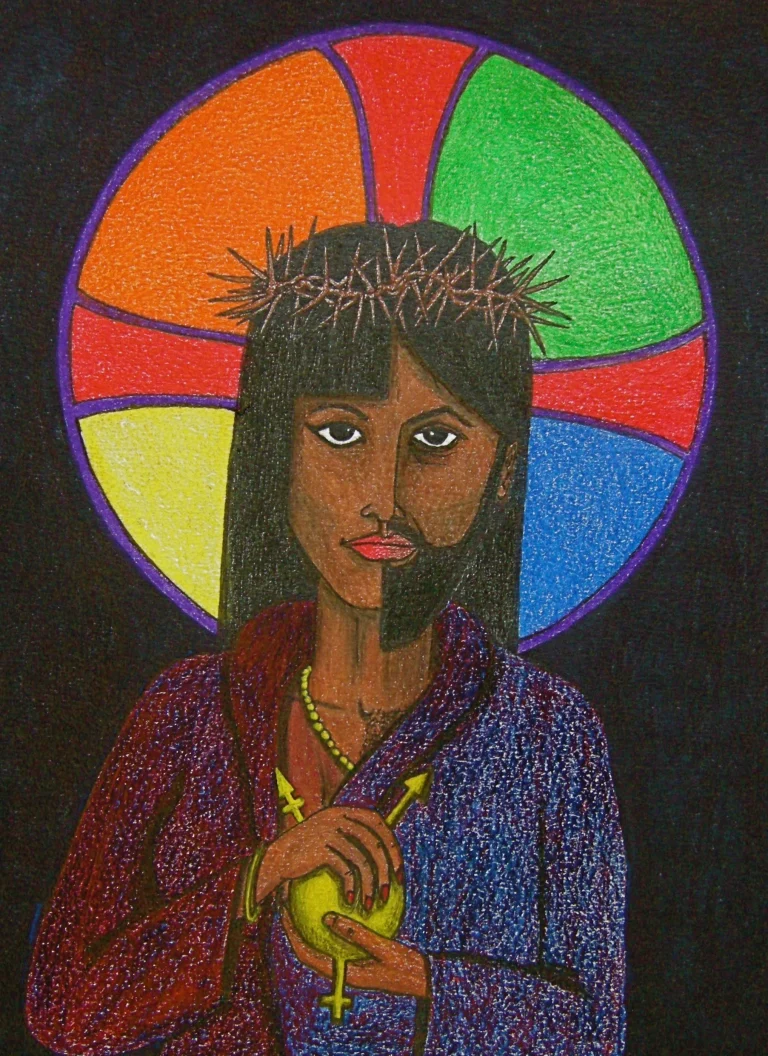
For something to be “queer,” it actively undermines attempts at definition and categorization. The truth of what it is is simply too infinitely vast to be contained. Our categories, such as “parent,” “spouse,” “democrat,” “receptionist,” etc are like a cup of water. Our True Selves are what is inside of that glass, and it is constantly overflowing out of the top and spilling across the table. We are the overflow. That’s what it means to be queer. And we are often taught that the church isn’t the building, but the people. And there are queer people within that building. So that must mean that the church is queer too. And we are made in the Image of God, the Imago Dei. So that must mean that God is also queer!
For the church to recognize that people are queer is to recognize itself as queer. The church then achieves a certain level of self-awareness, a hallmark of spiritual maturity. Spiritual growth can be measured by one’s awareness of themselves, of the world around them, and their Source. In coming out of its closet as a queer entity, the church knows its queer self, knows the queer world in which it resides, and knows its queer Creator. The church is then engaging with Ultimate Reality.
The church can only be successful as the Body of Christ if it does not seek to be a controlling or dominating agent within the world. Christians must continually seek to live “out of control,” as Stanley Hauerwas states (“Reforming Christian Social Ethics: Ten Theses”). We should live in such a way that does not demonstrate the insecurity of a people who are dependent on the violence of the systems of control that surround us. The world that the powerful want to impose on us does not reflect the true queer nature of the world. Because we are servants of the real world in all of its queerness, we are not subject to the whims of the heteronormative power brokers. We do not seek control or to invite those who do to bed with us.
“Trust is impossible in communities that always regard the other as a challenge and threat to their existence” (Hauerwas, “Reforming Christian Social Ethics, Ten Theses”). Vines’ assessment of non-normative identities distorts reality into perceiving us as threats. And we are threats. But we are threats precisely because we see the violent, heteronormative, and patriarchal systems of power for what they are. We are threats to power, and lovers of the powerless. We “comfort the disturbed and disturb the comfortable” (Cesar Cruz). Because Vines has chosen to side with these systems of control, his prophetic witness to power has dissipated. He has chosen to diminish the church’s trust in LGBTQIA+ people and to destroy the queer community’s trust in him.
The Christian faith is a queer community. We are a strange bunch. We are always on the move, just as Christ was. We cannot be contained within a definition or a category. We are represented by a diverse and queer history of prophets who felt the Spirit of God move them against the currents of power. And in being these wild people of The Wilderness, we are thus able to rightly confront power and control and name it as it truly is: deep insecurity.
I pray that Vines finds his prophetic voice – that he no longer seeks to live within control but to abandon systems of control altogether. I pray that he realizes that to be gay is to be abnormal, which is fitting for a follower of Christ who was butchered by the religious authorities and the State for not complying with imperial norms. May Vines find himself, and may we all. Amen.