


I’m going to say something controversial, so brace yourself:
Matthew Vines is right.
Don’t worry, I’m not stopping there. He’s right about just one thing: his position of privilege as a white cisgender gay man is eroding. That’s what his article boiled down to.
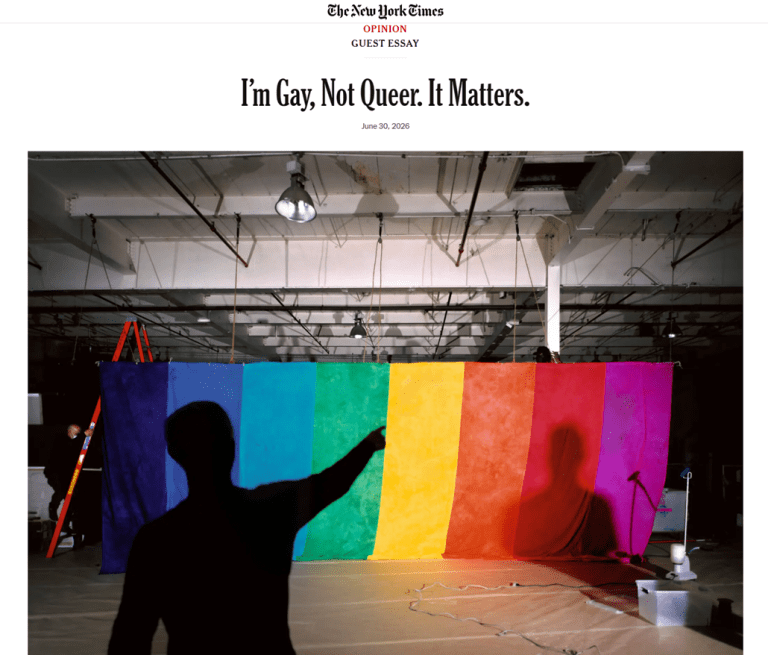
In case you haven’t read about the controversy, the New York Times published an opinion piece by well-known gay Christian author Matthew Vines, which claims that use of the term “queer” has threatened the existence of legalized gay marriage. The piece is titled “I’m Gay, Not Queer. It Matters.” The essay prompted widespread outrage among LGBTQIA+ people and their allies online, and we at the Where True Love Is movement echo the disappointment and irritation.
Hey Matt! Check your privilege
Over a decade ago, Vines found a way to convince himself, some of his family members, and many good-hearted Christians, that certain scriptural laws and approbations didn’t apply to him. Parsing particular Bible passages was a common way to battle Christian discrimination at the time, so that’s the approach he used in his arguments. But I’ve always thought focusing on clobber passages is like staring at a piece of tree bark so intently that you miss the grandeur of the forest.
My own writing about queer inclusion takes a different approach, which sprung from a deepening understand of scripture. It’s not a handbook or rule book for godly modern life. The Bible is a collection of ancient peoples’ attempts to make sense of a confusing world. It tries to answer questions about how humans came to be, why suffering exists, what might come next, and how to avoid the wrath of a god who (they believed) afflicts violence on the disobedient. Many of these books were put into writing after being passed from generation to generation around campfires, as cautionary tales and oral histories. Stories to entertain, to enlighten, to encourage, to protect. Other books captured issues related to land ownership, the succession of kings, or statistics about populations. After the crucifixion of Jesus, books were added to describe his teaching and the growth of the early church. Each book in the Bible had an originally intended purpose appropriate to and understood by the culture of the time. Throughout the centuries, different collections of the writings were compiled by various people or committees and labeled “canon,” though which books were included or excluded varied by faith tradition. These collections were translated by humans across the centuries, who applied the scholarly and scientific information available to them in their eras.
Translation always, always takes place within in a cultural context. Even AI can’t save us from that reality, at least not yet. And there is no biblical commandment or Traditional injunction that says translations are infallible.
Given all these realities, arguing about specific lines or phrases of scripture seems silly to me. It’s too limited, and too counterable by someone else’s opposing line or phrase. Participating in “verse off” arguments isn’t effective, and doesn’t follow the example of Christ.
Back to Matthew Vines’ book, which came out in 2014, at the start of the now-booming business of books for queer individuals who want to follow the way of Jesus. Vines worked hard to effectively accomplish a specific task: mansplain the handful of verses which address men having sex with other men.
Vines could only write from his own experience. His work is an artifact of the era in which it was written. An era which produced Hillbilly Elegy by JD Vance, another Ivy-League-degreed, suit-and-tie-wearing white man. Each of us can only think from the perspectives whirling around our individual belly buttons. So Vines wrote from a position of significant privilege, to an audience which held similar privilege, kind of like he was applying to a country club and explaining why a few bylaws shouldn’t prevent him from playing golf and sipping Diet Coke with those who were otherwise pretty darned similar to him.
As I said, it was an artifact of his era.
But we’re all called to learn, grow, and adjust our understanding as our years unfold. How wonderful would it have been if Vines penned a new book reflecting the current state of queer rights and demonstrating growth in his views. Instead, we got the NYT piece, in which he doubled down on his early privileged position. His website confirms this reality. Check out the second sentence on the home page:
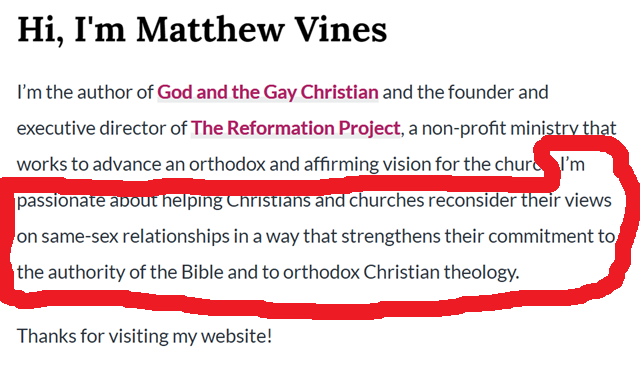
I believe he is passionate about his stated objectives. I also believe he doesn’t recognize the sizeable constraints included in several parts of this statement. For example, does he want to help expand affirmation of LGBTQIA+ individuals more broadly or just for same-sex relationships? Is he interested in challenging the concepts about what “biblical authority” means and what constitutes orthodoxy, or does he merely want to jam a limited set of controversial views in to cover his own area of biblical “sinfulness?”
The opening words on Vines’ home page, and his expanded defense of a “no queers” position in the recent New York Times opinion piece seem to make his view clear. Instead of moving deeper into an exploration of a God who is Love, he’s nestling further into the privilege enjoyed by being a cisgender gay white man.
Vines’ inner dinosaur is showing
I shook my head several times while reading Vines’ essay, which resounded with big “GET OFF MY LAWN” energy. For example, he writes:
“…in 2025, 48 percent of L.G.B.T.Q. people said they thought of themselves as queer, including nearly 60 percent of those under 30. Progressive activists, organizations and major media outlets now routinely use “queer people” as an umbrella label for everyone who isn’t heterosexual, often paired with “trans” to encompass the broader L.G.B.T.Q. population.”
Vines continues:
“But the capaciousness that makes “queer” appealing to some also makes the term remarkably easy for anybody — regardless of orientation — to adopt as a kind of radical chic identity label.”
(Regardless of orientation is telling, once again. In Vines’ mind, the only queer people who matter are those who experience same-sex attraction.)
…”That elasticity has helped fuel a sharp rise in young people identifying as something other than straight, even if they are unlikely to ever pursue a same-sex relationship.”
Vines’ apparent ignorance of gender identity, intersex conditions, non-binary indigenous spiritual understandings, romantic attraction variance etc. is shocking. Given the widely available information on these subjects, its hard not to interpret his words as a defense for remaining bigoted, judgemental, and exclusionary.
Rights and inclusion for gays and lesbians? DEFINITELY!
Rights for others who are marginalized and demonized by our churches and our nation? Not his problem.
Vines’ concluding words
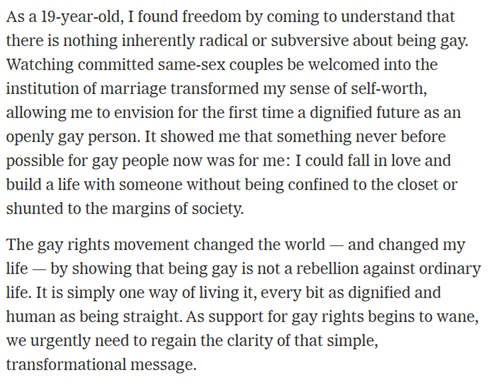
This is what I hear as I ponder these passages:
Gays and lesbians are every bit as dignified and human as heterosexual people, and shouldn’t be closeted or shunted to the margins. Trans folx? Gender expansive peeps? Intersex individuals? People who can fall in love with someone regardless of their sex or gender identity? They’re kind of sketchy. Maybe let’s not talk about them. Maybe God doesn’t actually like them. Maybe they’re pervs even.
If Vines is auditioning for the role of JD Vance’s running mate in the next presidential election, this could be a pretty solid stance. But if he wants to be seen as a proclaimer of the equal dignity of all human beings, a follower of The Way which is love incarnate, then may the outcry against his words settle deep within his heart, and bring about change.
My take on the word “queer”
Declan and I have talked about the use of queer quite a bit over the past few years. I embraced it pretty quickly because it felt like such a great fit for me. I’m asexual (sorry Matthew, but we exist), was assigned female at birth but don’t conform to gender performance norms, and am married to and deeply love a transgender man. I’m not straight but I’m not gay, and my safety, rights, and inclusion are definitely not ensured. My husbands even less so. We’d be far safer closeted.
Our work has always been to help people explore the idea that the force which powers the universe is far more expansive and all encompassing than we can imagine in the coconut-sized confines of our brains. If anything is divine it is love, that thing which raises us all to higher levels of self-donation and generosity, which fills us with gratitude and yearning, which opens our hearts to forgiveness, mercy, compassion, and welcome. Our world and all the universes are filled with queer things, existing in riotous harmony if allowed to simply be.
Let’s be honest, Matthew. Your gripe isn’t about a word. Use of “queer” as a term isn’t your problem. It’s queerness itself which upsets you, which challenges the social hierarchy, which upsets the platform you’ve built.
And that’s simply too damn bad.
We’re here. We’re queer. God loves us. Do better.
If you’d like to read books which approach these topics in a God-who-is-love centered way, consider the following titles:
Where True Love Is: An affirming devotional for LGBTQI+ individuals and their allies
Transfigured: A 40-day journey through scripture for gender-queer and transgender people
Sex With God: Meditations on the sacred nature of sex in a post-purity-culture world
 If you’d like a book the idea of a new sacred sexual ethos, consider this title: