

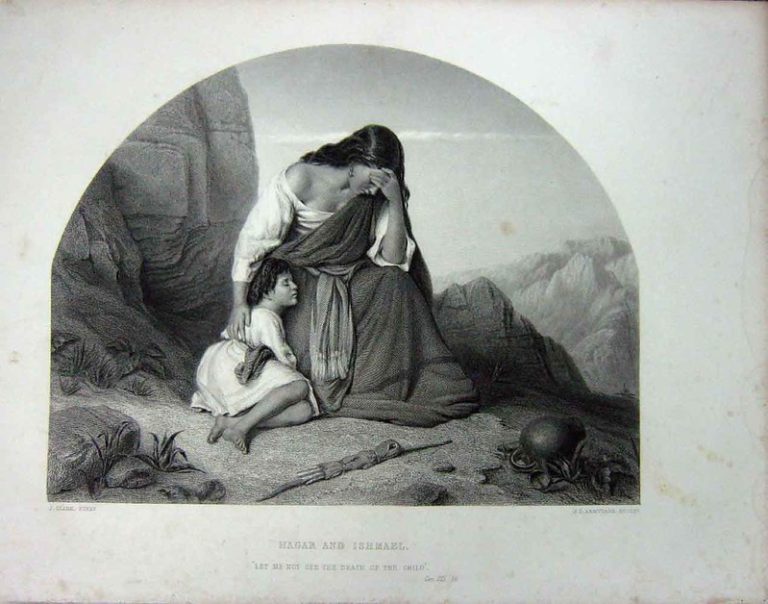

Sarah saw the son of Hagar the Egyptian, whom she had borne to Abraham, playing with her son Isaac. 10 So she said to Abraham, “Cast out this slave woman with her son, for the son of this slave woman shall not inherit along with my son Isaac.” 11 The matter was very distressing to Abraham on account of his son. 12 But God said to Abraham, “Do not be distressed because of the boy and because of your slave woman; whatever Sarah says to you, do as she tells you, for it is through Isaac that offspring shall be named for you. 13 As for the son of the slave woman, I will make a nation of him also, because he is your offspring.” 14 So Abraham rose early in the morning and took bread and a skin of water and gave it to Hagar, putting it on her shoulder, along with the child, and sent her away. And she departed and wandered about in the wilderness of Beer-sheba.
15 When the water in the skin was gone, she cast the child under one of the bushes. 16 Then she went and sat down opposite him a good way off, about the distance of a bowshot, for she said, “Do not let me look on the death of the child.” And as she sat opposite him, she lifted up her voice and wept. 17 And God heard the voice of the boy, and the angel of God called to Hagar from heaven and said to her, “What troubles you, Hagar? Do not be afraid, for God has heard the voice of the boy where he is. 18 Come, lift up the boy and hold him fast with your hand, for I will make a great nation of him.” 19 Then God opened her eyes, and she saw a well of water. She went and filled the skin with water and gave the boy a drink.
20 God was with the boy, and he grew up; he lived in the wilderness and became an expert with the bow. 21 He lived in the wilderness of Paran, and his mother got a wife for him from the land of Egypt.
– Genesis 21:9-21, NRSVue
I came out as a gay man publicly on February 10, 2015. By that time, I had already made sure to tell everyone I was closest to – my family was already well aware and fully supportive. My closest friends already knew. Now it was time to tell everyone else. I had just graduated with a bachelors in Youth Ministry. Throughout the years leading up to that moment, I had interned at churches across the country. I had networked with ministers and laity in many congregations. I had been on track to having a successful life in ministry in the denomination that I was in at the time, the Churches of Christ – a typically highly conservative and fundamentalist branch of the Stone-Campbell Movement. All that I needed to do was live a lie. But I knew that was not the life to which God had called me. God had called me to a life of ministry – and ministry is about proclaiming truth.
I was sitting at a table in one of the small community centers on campus at my school, Oklahoma Christian University. I typed up a very long Facebook post, stating my identity as both a child of God and a gay man. I hit “post” and shut my laptop, turned off my phone, and went for a long walk. I knew that while I was strolling in the sunshine my entire life was rapidly changing. I knew that my entire career network had been destroyed. I knew that I could never show my face as my True Self at my home church in Bixby, Oklahoma ever again. I knew that I had just lost a large amount of friends. I knew that a page had turned and I had started a brand new chapter of my life. I had wandered into The Wilderness. And there was no going back.
In today’s Lectionary reading, the slave of Abraham and Sarah, Hagar, had also found herself in the Wilderness. Even though YHWH had told this family that they would conceive, Sarah believed that her being postmenopausal made the thought of her giving birth laughable. So she told her husband to sleep with their young slave to produce an offspring. That way, Abraham’s lineage could be secure.
In putting Hagar into this horrible position, Sarah was really doing to Hagar precisely what had already been done to her. Previously, Abraham had taken Sarah all the way to Egypt and gave her to Pharoah to do with her however he wished. Dr. Amy-Jill Levine and Dr. Douglas A. Knight point out that “just like Sarah, Hagar was dragged across the desert after being taken from her homeland and placed into the bed of an elite man so that someone else could benefit from the ‘services’ she provided” (Douglas A. Knight and Amy-Jill Levine, The Meaning of the Bible, p. 235). The cycle of abuse is therefore perpetuated from the abused to another victim.
Hagar was taken advantage of by those in power over her. And after Sarah actually managed to give birth to her own child, Isaac, Hagar was driven out into The Wilderness so that her son, Ishmael, would not reap the family benefits that Sarah wanted for Isaac. She is utterly abandoned by a system that had enslaved her, used her, and cast her aside when her usefulness was no longer needed. And that is precisely where God introduces godself to her.
Ours is not a God of the powerful. Ours is the God of the marginalized. Ours is not a straight, white, male, cisgendered god. Ours is a wild and queer God!
The Wilderness is a theological term that is used a lot throughout Scripture. In both the Hebrew Bible and the New Testament, the term is used to describe a liminal space – a space that is outside of the normal patterns of the world. The Wilderness is far away from civilization, far away from Empire. The Wilderness is where a person is led when they are about to undergo a profound metamorphosis that will put them at odds with the systems from which they came. And The Wilderness is where you meet God.
The Wilderness is where the Hebrews were sent to wander for forty years after their freedom from captivity in Egypt, being led by YHWH in the form of a mysterious pillar of smoke by day and a pillar of fire by night. In the Gospel accounts, John the Baptist is a representative of the Wilderness, a wild prophet proclaiming the coming of Christ to Herod. The Wilderness is also where Jesus is tested for forty days. And, The Wilderness is where Jesus is Crucified – Golgotha was outside of the city gates.
And The Wilderness is where Hagar is at her wits end. Starving and dehydrated, she places the child Ishmael under a nearby bush and sits down far away from him, because she doesn’t want to watch him die. And she gazes up at the sky and sobs. She is done, truly at the end of her rope. All hope has been lost. She has nowhere else to turn, no chance of survival in this strange place far away from people.
Suddenly, an angel of YHWH speaks to her. The text tells us that God has heard the cry of the boy and has come to ask Hagar what troubles her. And then something truly incredible happens: God makes a covenant with Hagar. YHWH tells Hagar, “Do not be afraid, for God has heard the voice of the boy where he is. Come, lift up the boy and hold him fast with your hand, for I will make a great nation of him.” This goes along with Ishmael’s name, which means “El Hears,” or “God Hears.” It has the same root as the word Shema, the sacred Jewish prayer that states, “Hear O Israel, the Lord Your God is One.” And this covenant mirrors the covenant that YHWH made with Abraham earlier, where YHWH also promised that Abraham’s offspring would grow into a great nation and God will be his God and that nation will be God’s people.
Something else happens that is not told in this account of the story, but does happen a bit earlier in Genesis. This story is actually told twice, likely due to there being two different authors describing the same thing. In the earlier account, in Genesis 16, right after YHWH makes the covenant with Hagar, she becomes the first human in the Hebrew Bible to give God a name – she names YHWH El Ro-I, which means “The God Who Sees Me.” So Ishmael is named God Hears and his mother names YHWH The God Who Sees Me. This is a story about the Creator of the cosmos seeing, hearing, and honoring the cries of the marginalized.
One of the most important parts of this story is actually Hagar’s name. This can often be overlooked. But there is profound power in her name. The word “Hagar” can have two meanings in Hebrew: on the one hand, it can mean “Splendid;” and on the other hand, it can mean “The Stranger,” Ha being the general article and Ger or Gar meaning Stranger. So Ha-Ger or Ha-Gar means The Stranger. And these two meanings are absolutely perfect for this account, because God is looking with favor on the outcast. The Stranger who has been cast out is seen by YHWH as Splendid and God hears the cries of Ishmael in The Wilderness.
This is a story about a young woman who has been used and abused by those in power over her. She has been cast aside and thrown into the terrifying and mysterious Wilderness. She is a Stranger in a strange land, an Egyptian slave living far from her homeland. And God has looked on her, of all people, with favor and has formed a covenant with her. Ours is not a God of the powerful. Ours is the God of the marginalized. Ours is not a straight, white, male, cisgendered god. Ours is a wild and queer God!
I know that the word, “queer,” carries with it a ton of baggage. For decades it has been used as a slur against those of us who are gender and sexual minorities. But it is also true that since the eighties, many of us have used it to describe ourselves so that we take that power back. And because, in gender studies and in theology, queerness means that which refuses to be defined. To be queer is to declare that we do not exist in a tidy and neat box that can perfectly describe who we are. We cannot be contained by categories. We are, in that sense, liminal beings.
Another way of describing queerness is “strangeness.” We exist outside of the established heteronormativity. We are different. We are beautiful. And we are beloved. This is also how “holiness” is defined. The word “holy” is often misunderstood. It is all too often used as a way to describe someone who is simply better than other people. But holiness actually means that something has been set apart from the rest. For something to be made holy, or sanctified, it has been made strange. Or, it has been made queer. Queerness is holiness. Holiness is queerness. And being placed on the margins is quite literally being set aside. So the Holy is in the margins, rather than the center. You will not find God in a space that is not welcome to the Stranger, the Queer, the Holy.
One of my favorite theologians, Rudolf Otto, at the turn of the last century in his book, The Idea of the Holy, popularized a theological term that I think can be used right alongside the word “queer.” That word is “numinous.” He used that word to describe that which cannot be described but only experienced. The incredible feeling of awe you get when you are moved to tears by a song or gazing at a painting or standing alone in the center of a massive cathedral at night, lit only by candlelight. It’s the feeling of the Dark Forest, the terror you feel when you realize that you are lost and you don’t know what’s lurking between the pines. Another word that he uses to describe this experience is Mysterium Tremendum, the Tremendous Mystery. And what an apt name for God!
Empire wants us to be easily understood, easily defined, easily categorized because that would make us easy to tame or domesticate. And when we realize that we can no longer play along with the straight world imposed by those in power, we fling the masks off of our faces and reveal our True Selves in glorious and holy and sacred rebellion. And when we are placed outside of the lines drawn by the Empire, God meets us out in the untamed Wilderness outside of our closets.
Lesbian, Gay, Bisexual, Transgender, Queer or Questioning, Intersex, Asexual, Two-Spirit, and everyone who has been cast aside by power, vilified by the Empire, and scapegoated by insecure men are favored by the God Who Sees And Hears Them. We are not just welcome at the Table, but we have always been here. When the Church has chosen to marginalize us, the Church has only chosen to harm itself because the Church is queer too.
I remember being taught the common refrain, “the Church isn’t the building, it is the people in the building and beyond.” And I still agree. But guess what? There are LGBTQIA+ people in that building. So that must mean that the Church is queer too. And straight, and Black, and white, and disabled, and poor, and every other member of the beautiful symphony of humanity. The Church is exactly as diverse as humanity. And we are also taught that we are made in God’s Image, the Imago Dei. So if we’re queer, that must mean God is too!
That is why Hagar is given the honor in this story of being the first to name God, she has a covenant established with God, and she is spoken to by the Mysterium Tremendum. Because her name is The Stranger, Hagar is also The Holy and The Queer. And she is seen, heard, and favored by God. And, if you are on the margins, if you are that queer kid out in The Wilderness, God sees, hears, and favors you too.
After that fateful Facebook post eleven years ago, I have continued to deepen my walk with our queer God of The Wilderness. I have learned through study and prayer and community that God is not just an ally, but is marching in the Pride parade with us. God is getting hit with the same stones that we are. God suffers and celebrates alongside us and amongst us and within us because God is the gay kid getting kicked out of the church too.
So my friends, during this glorious Pride Month, though we are very much in the thick of Empire, though we are very much surrounded on all sides by rampant Christian Nationalism masquerading as the Way of Christ…know that you are holy and sacred. In our queerness as both LGBTQ+ people and allies, we are numinous and holy and wild creations of our numinous and holy and wild God. No matter what the Empire throws at you, know that you are beautifully and wonderfully made precisely as you truly are. Amen.